
 Driven by curiosity. Driving change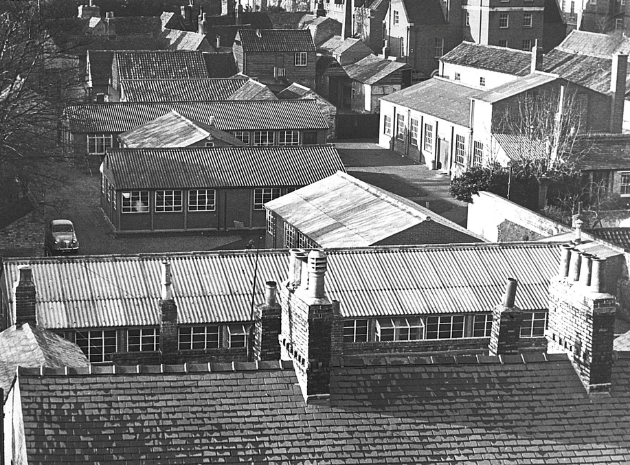
The Department moves into temporary facilities off Tennis Court Road. One academic compared their design to the codebreaking ‘huts’ of Bletchley Park.
Terence Fox is appointed as the first Shell Professor of Chemical Engineering and Head of Department.

Head of Department 1946 - 1959
The first Shell Professor of Chemical Engineering and Head of the Department of Chemical Engineering, Terence Fox had an engineering degree from Cambridge industrial experience from his time at Imperial Chemical Industries (ICI).
He did everything from devising the original teaching course to instituting morning and afternoon tea breaks for staff and students to share ideas (a tradition still enjoyed by the Department today).

The department’s first permanent home is designed by Scottish architect John Murray Easton and comprises 22,000 square feet across five floors. This building houses the Department for the next 57 years.
Peter Danckwerts, a decorated war hero becomes the second Shell Professor of Chemical Engineering and Head of Department in 1959.

Head of Department 1959 - 1975
A decorated war hero, Peter Danckwerts earned a George Cross for his work defusing parachute mines dropped on London during the Blitz.
Peter Danckwerts’ work is vital to the fields of reaction engineering and gas absorption and mixing. He served as President of the Institution of Chemical Engineers (IChemE) from 1965 to 1966.

PhD graduate 1964
One of India’s foremost chemical engineers, Man Mohan Sharma, earned his PhD while studying under Peter Danckwerts in the Department. At just 27 he became Professor of Chemical Engineering at the Institute of Chemical Technology in Mumbai. In 1990, he became the first Indian engineer elected as a Fellow of the Royal Society (FRS).

Researcher - 1946 - 1969
A founding member of the Department of Chemical Engineering, Tom Bacon developed the hydrogen-oxygen fuel cell that would go on to power Apollo 11 to the Moon in July 1969.

Head of Department 1975 - 1993
The founding father of fluidisation became Head of Department in 1975.
A long-time member of the Department, Davidson wrote the influential text Fluidised Particles (1963) alongside fellow academic David Harrison.
John Davidson passed away on 25 December 2019 at the age of 93.
Image: Trinity College - Cambridge

Formed as The Biotechnology Centre under the directorship of Chris Lowe, the Institute of Biotechnology (as it was known from 1988 onwards) gets its start in a ‘hut’ on the Downing Site.

Lynn Gladden is appointed the first female lecturer in the Department of Chemical Engineering.
The Institute moves into purpose-built laboratory space, making space to recruit more academics and postgraduate students.

Head of Department 1993 - 1998
Bridgwater was a graduate of the department with industrial experience at Courtaulds. He had been a lecturer in Cambridge in the 1970s, and a Professor at the University of Birmingham in the 1980s. His research focused on particle science, including flow of particles and pastes.

Head of Department 1998 - 2006
A biochemist, Howard Chase became Head of Department in 1998. His research area was bioseparations technology, for instance chromatography in expanded bed adsorption columns.
His tenure saw a significant refurbishment of the laboratories for chemical and biochemical preparations and the introduction of the MPhil course in Advanced Chemical Engineering.
Image: Magdalene College - Cambridge

The Department’s first female lecturer became its first female Head of Department in 2006. Her research applies magnetic resonance imaging techniques to chemical engineering challenges.
She served as the University of Cambridge's pro-vice chancellor for research from 2010 to 2016 and was knighted for services to academic and industrial research in chemical engineering in 2020.
The move creates the Department of Chemical Engineering and Biotechnology (CEB) and enables the new combined department to build upon the strengths of both its predecessors.
Professor Dame Lynn Gladden becomes the first Head of the new Department of Chemical Engineering and Biotechnology.

Head of Department 2010 - 2015
Nigel Slater had a chemistry background before becoming a lecturer in the Department in 1979. After a 15-year spell in industry, he returned to the department in 2000 and became the Head of Department in 2010.
His research area was the manufacture and formulation of biopharmaceuticals.
Image: Fitzwilliam College - Cambridge

The first digger begins excavations on the site of the Department’s current home in May 2013. Construction of the building would take the better part of three years to complete.

The specialised doctoral training programme admits its first cohort of students. The Centre is hosted by the Department under the direction of Professor Clemens Kaminski

Head of Department 2015 - 2018
A Department alumnus, John Dennis returned as an academic in 2002 before becoming Head of Department in 2015. He oversaw the Department’s move into its new building over the course of 2016.
His research interest is combustion in fluidised beds. In 2018 he became the Head of the School of Technology.

The Department’s current home is formally opened by The Lord Sainsbury of Turville, Chancellor of the University of Cambridge, on 24 April 2018.
Head of Department 2018 - 2020
Lisa Hall was one of the founding members of the Institute of Biotechnology and the first female professor of Queen’s College Cambridge. Her research focuses on analytical biotechnology, particularly molecular sensors for chemical and biological systems.
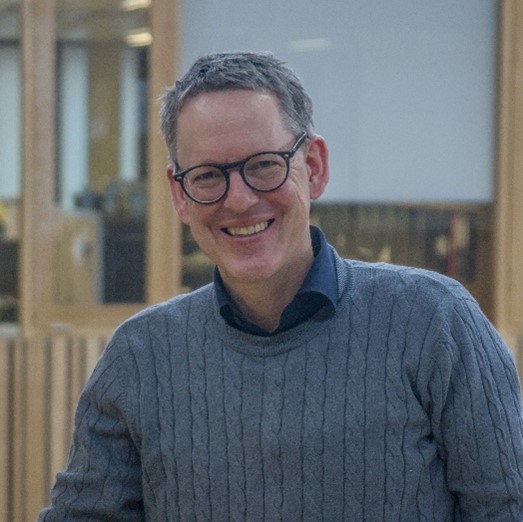
Head of Department 2020 - present
Professor Clemens Kaminski's research focuses on the development and application of optical imaging methods.
Example applications include quantifying the kinetics of reactions in chemical and biological systems, developing chemical sensors, and the microscopy of biological systems for healthcare.

For the first time, the Department of Chemical Engineering and Biotechnology admits undergraduate students onto its own Tripos, independent of the Natural Sciences Tripos which had incorporated the Department’s teaching up to that point.